The Printer ICM
The Internet Capital Markets platform for memecoins — fully open on Solana, with Robinhood Chain already running a live pipeline of its own and BNB Chain right behind. AI that scans the whole chain in real time, grades what it finds, and pushes clean signals straight to your browser and your Discord — with a full dashboard, an AI agent and autotrading behind it.
Overview
The Printer, by Bobnet AI, started in January 2023 as a Telegram signal service. It has grown into an autonomous, self-learning AI system that analyses on-chain data around the clock and surfaces the memecoins worth watching — before they pump.
You get the calls where you already are — in the Chrome extension and in Discord — plus a public Total Control Dashboard that shows the live track record, and automation to trade them hands-off. No 200-messages-a-day spam. No hidden results.
- Signals — entry and sell alerts, each graded by conviction.
- Delivery — the Chrome extension is the fastest seat in the house: the card is on your screen in under a second. Discord carries the same call seconds later, split by level, and the message updates itself if a safety check lands late.
- Dashboard — every confirmed signal, win rates, runners, sentiment.
- Automation — the ICM Fund (AFK Mode), auto-trading and the shared wallet act on signals for you.
Chains
The Printer is going multichain, one chain at a time. The public dashboard now opens with a chain selector — pick a chain and everything behind the door (signals, stats, runners) belongs to it.
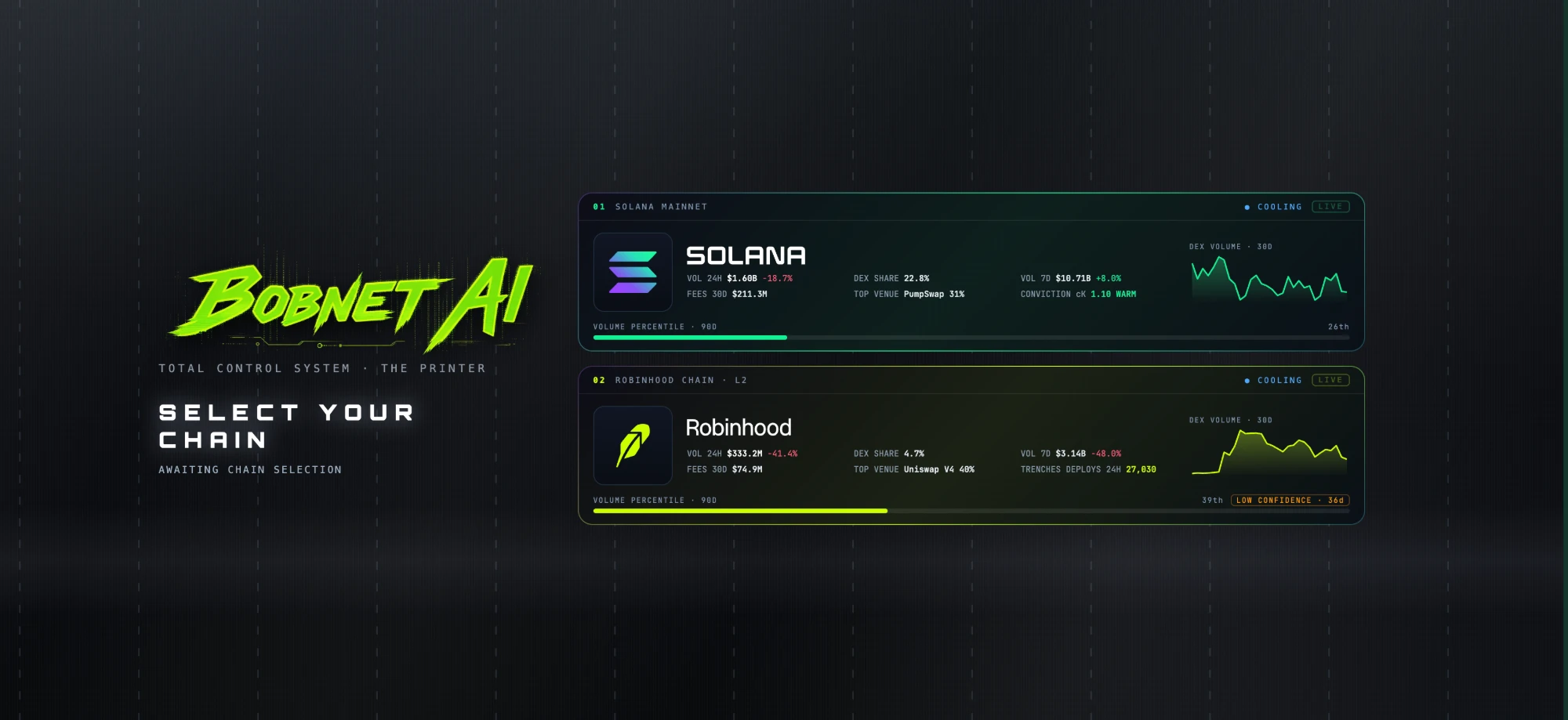
① Solana — open
The one chain fully open to the public today: the complete product — graded signals delivered to the Chrome extension and Discord, the Total Control Dashboard, the ICM Fund and the AI stack.
② Robinhood Chain — live, calibrating
Robinhood Chain already runs on a pipeline of its own — its own token universe, its own price history, its own long-runner track and its own trader board — behind /hood (members). It stays watch-only, with no levels and no sizing, until forward results say the grading is calibrated.
③ BNB Chain & more — soon
Binance Chain and further chains will be introduced shortly — each one behind the same selector, with the same honest track record from day one.
The mission
Make degens' lives great again
Memecoin trading is mostly gambling — noise, scams, and 18-hour screen days. The Printer's mission is to replace the gambling with a bias-free system: scan everything, cut the traps, grade the survivors, and give traders an edge they can actually see and audit.
The goal isn't more signals — it's better ones, delivered with the conviction and the tools to act on them.
Core tech
An advanced, bias-free intelligence framework built to surface and grade memecoin signals before they run — the same framework on every chain we open.
- Real-time on-chain data — the engine reads every new token and every trade as it lands, chain by chain.
- 500+ metrics per token — each token is measured across a large set of proprietary signals.
- Kill rules first — bundled launches, rugs, honeypots and wash trading are filtered out before anything reaches you.
- Graded output — survivors get a conviction score and a level, so every call carries how strong it is.
- Delivered the moment it fires — a graded call reaches the Chrome extension in under a second and Discord seconds later, so what you read is what just fired.
You never need to touch the internals — the dashboard shows the outcome of every call the system makes.
Get access
- Join the Telegram community — the front door: announcements, drops and where to ask before you buy.
- Grab a membership.
- You unlock the private Discord where the signals land, the Chrome extension, the dashboard and the ICM Fund.
How members get into the dashboard
The Total Control Dashboard is gated. Hit Open Dashboard anywhere and the access popup opens — one popup, two paths, both ending in the dashboard.
The visitor clicks it → the access popup opens
the gated, members-only dashboard
Your wallet signature is the login — no passwords, no seed phrase, nothing to paste.
What a membership gets you
Wallet or Telegram — more than one way in
At checkout your paying wallet is captured alongside your email, X and Telegram. A membership is a bundle of those identities, so you can prove access more than one way:
What the access layer sees — and never does
The access layer is deliberately thin. Your trading edge lives elsewhere, behind its own wall.
The portal knows
- your wallet & balance
- your membership + expiry
- your contact from checkout
It never sees
- the trading alpha & signal logic
- the scoring recipe
- your keys or seed phrase — ever
Guide to use
Use The Printer as your trading partner, not a slot machine:
- Run the extension. It is where the call reaches you first — the live feed in the side panel, an alert window you can tune by level, and a safety check on every signal.
- Watch the level. Every call is tagged Netrunner / L1 / L2 / L3 — size to the level.
- Check sentiment. The dashboard's sentiment read tells you the backdrop you're trading into.
- Act cleanly. Open the chart straight from the signal — in the extension panel or from the Discord message — or let the ICM Fund (AFK Mode) handle the entry and exit.
- Respect the sells. When the system issues a sell, it's telling you the trade is done.
Overview
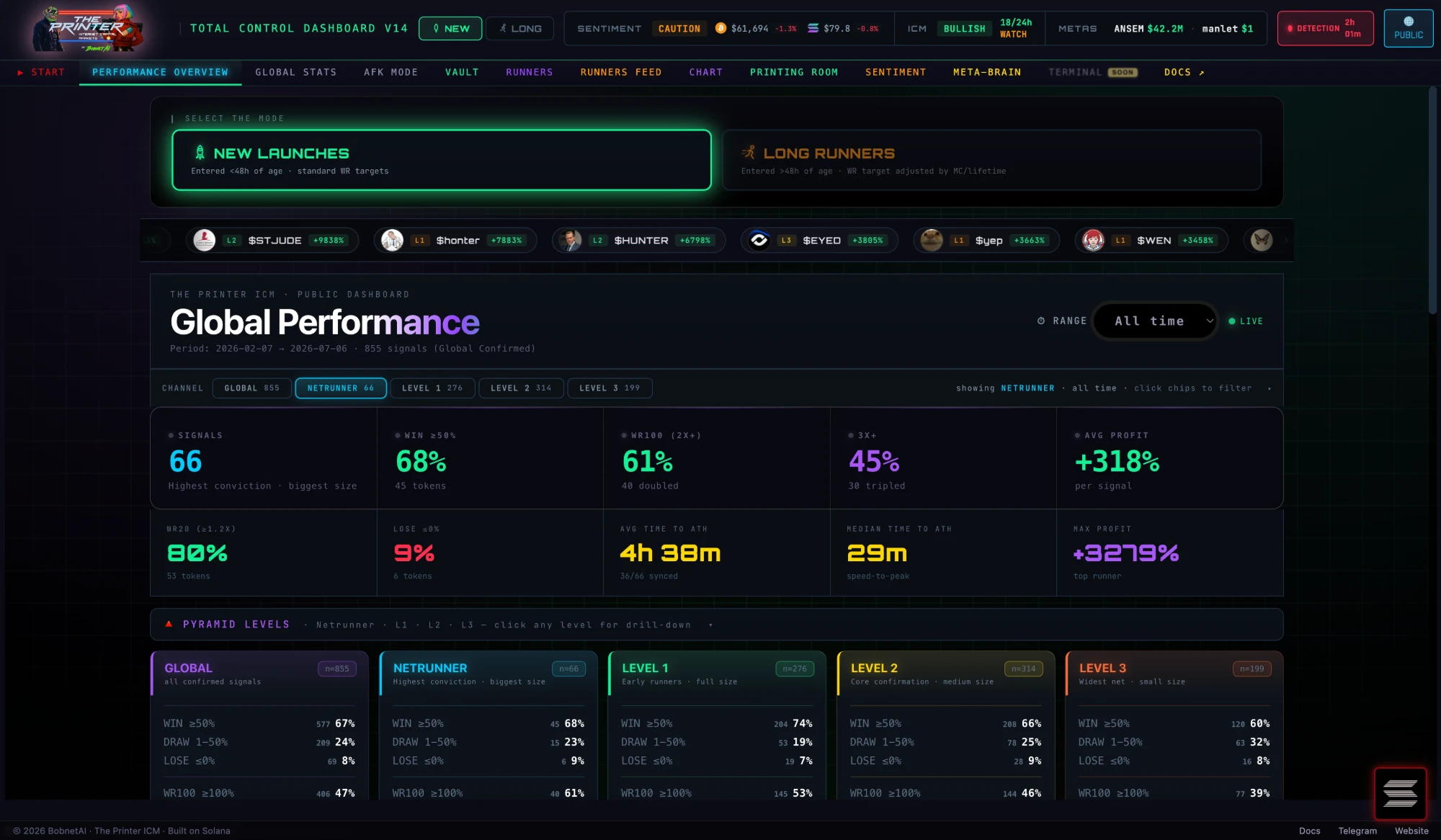
Total Control — the live face of the system. Signals reach you the moment they fire — seconds to your Discord channel, near-instant to the Chrome extension's side panel. This page is the public view of the same data, rebuilt continuously and served on a short delay behind the engine. This group is the numbers: performance, stats, and the runners it caught.
Every view in this group exists twice. Solana is one chain; the Robinhood chain runs beside it on its own pipeline — its own universe of roughly 900 tokens, its own candles, its own books and its own dashboard, with the same Global Stats, Runners and Runners Feed you get here.
Global Stats
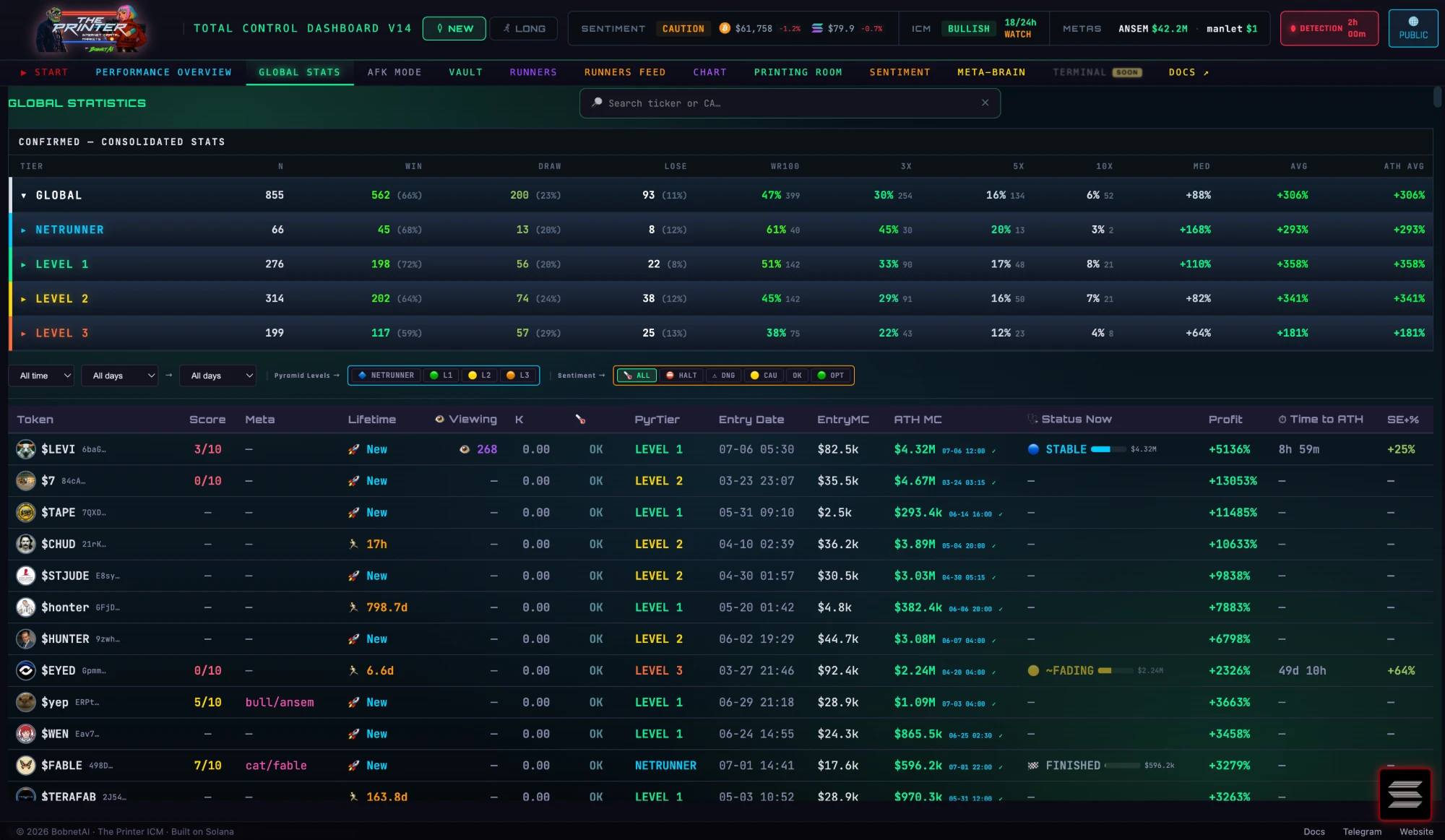
Pick a time range (last 24h → all-time) and see the whole system: win rate, median & average profit, tokens scanned and signals for the window, plus a per-level breakdown. The Global Statistics view lists every confirmed signal token-by-token — search by ticker or contract, tap to open the chart, and see entry → peak, profit and time-to-peak on each.
The headline numbers count one signal per token. Only a token's first call feeds win rate, WR100, 3× / 5× / 10× and the profit figures. Later calls on the same token stay listed — you can still see them and open their charts — but they never count twice, so a single winner can't inflate the record by being caught again. And the reads are independent of one another: the same token can appear under more than one of them, each scored on its own signals.
How win rate is measured — it changes with the mode
A "win" is not the same thing in the two dashboard modes, so always read the win rate against the mode it's shown in:
- 🚀 New Launches (entered <48h old) — a fixed target. The headline Win rate counts every signal that reached +50% or more.
- 🏃 Long Runners (entered >48h old) — the target scales down with entry market cap, because a bigger, older coin rarely doubles. A small runner still has to 2×; a large one only needs a smaller move to count:
| Entry market cap | Counts as a win at |
|---|---|
| < $50k | +100% (2×) |
| $50k – $150k | +75% |
| $150k – $500k | +50% |
| ≥ $500k | +30% |
Independently of the mode, the dashboard also shows absolute multiple rates — WR100 (hit 2×), 3×, 5×, 10× — which always mean the same thing. A loss is any signal that ends at or below its entry (≤ 0%); a draw is positive but short of the win target.
Stats Charts
The same performance data, plotted. Signal outcomes charted entry to peak, so you can read the shape of the system's edge at a glance instead of scanning rows.
Runners
The wall of fame: tokens the system caught that went 3× or more. Filter by level and by new-launch vs long-runner, switch between card and table view, and click any card to open the chart. Entry → peak on every one — the receipts page.
Runners Feed
The live feed of fresh candidates the engine is watching right now — before they've necessarily made the wall of fame. Where you catch a runner while it's still running.
Chrome Extension
The flagship — everything that matters for trading, docked beside whatever you are reading
The signal feed, out of the tab — the Chrome extension is live, and it is the fastest way to get a call. Install it and The Printer follows you while you browse: every confirmed signal lands in the side panel the moment it is published, over a connection that stays open — no refreshing, no waiting for the next check.
This is the panel itself, not a mockup: the extension's own code and stylesheet, painting real signals on a 1-hour delay — the last 20 calls, then the top of the week by peak gain. Read-only here; members get it live and can act on every card.
- Live side panel — the member feed docked next to whatever you are reading: level, the K conviction factor, entry market cap, how far the call has run to its peak, and the time it fired. New launches, long runners and sells all land in the panel.
- Push delivery, not polling — signals travel down a connection the extension keeps open, so a card appears in under a second from the moment it is published. A background check runs underneath purely as a safety net.
- Alerts you control — choose which levels (Netrunner / L1 / L2 / L3) and which signal types may interrupt you. A signal that passes both gives you a system notification, an optional pop-up alert window that can pull itself to the front, and a sound — with a one-click mute in the panel header that silences the chime without hiding the alert.
- A safety read on every card — the at-signal safety verdict travels with the signal: CLEAN, WATCH, or worse, with its score. You see the risk before you decide, not after.
- Top signals — a ranking of the best calls by how far they ran from entry to their peak, over 12h, 24h, 2 days, 3 days, 1 week, 2 weeks or all time. Each window contains the one before it, so it reads as a leaderboard, not a set of slices.
- Search by address — paste a contract address into the header and pull up its signal without leaving the panel.
- AI Analysis, per signal — one click asks the agent for the on-chain holder picture plus how many times that token was called before, and at what price.
- One-tap execution — every signal card links straight out: the chart, API Mode, the Terminal, the sniper bot, and your trading front-end of choice. Click the card body and the address is on your clipboard.
- Chains — Solana runs in the panel today; the Robinhood Chain and BNB Chain lanes are in place and open next.
- Members only — connect it with the access code from your dashboard sidebar; an active subscription is required, one device at a time.
Anatomy of a card
Every card carries the whole decision: what fired, how much conviction it earned, what the tape looked like at that second, what the safety screen said, and where the token went afterwards. Top to bottom:
- ▲ BUY / ▼ SELL — the direction of the call. Sells use the same card in red with the exit reason in place of the market row.
- 💎 NETRUNNER · 🟢 LEVEL 1 · 🟡 LEVEL 2 · 🟠 LEVEL 3 — the level the read earned by live win rate. Higher level, stricter filter, bigger size.
- The read that fired it — the specific setup behind the call, so you can tell two calls on the same token apart. Each read carries its own record in Global Stats; they are independent and never borrow each other's numbers.
- 🚀 New Launch / 🏃 Long Runner — which lane it belongs to: a token caught at launch, or momentum already established.
- Prime Time / Off-Prime — the quality of the hour it fired in, measured inside its own lane. Not every hour of the day pays the same.
- 2ND / 3RD CALL — the token had already fired before. Only a token's first call feeds the win rate and the profit figures; later ones are shown, and badged, but never counted twice.
- DELAY — how long the system itself took, from the call it read to the card it published. It is our clock, on the card, in the open.
- K — the autotrading size factor for that read, times the live sentiment multiplier.
K 0.00means the ICM Fund does not take this one — the call is still a call, and it still counts in the stats. - Ticker & contract — click the card body and the address is on your clipboard.
- The chart, and MAX TO ATH — the price line since the call, and the best close reached after the signal was published. Closes, not wicks: it is the ceiling the trade offered, never what an exit would have paid.
- The market row — the regime at that second and the multiplier it applies to size, plus the two inputs behind it: BTC on 4h, SOL on 3d.
- The safety read — the verdict and score from the screen that ran before anything left the system: CLEAN, or worse, with the number behind it.
- MC at entry → peak and the exact time it fired.
One click out of the card
The row of buttons under every signal is the reason the panel replaces a screen full of tabs: the chart, the two execution front-ends, API Mode, the Terminal, the sniper, the per-signal AI read, and the clip studio — all on the card that just arrived, none of them a copy-paste away.
What you let through
You decide what is allowed to interrupt you, and a signal has to pass both gates to reach you:
- Levels — Netrunner, Level 1, Level 2 and Level 3 are switched on and off one by one.
- Signal type — new launches, long runners, and sell events. Sell alerts are paused while the sell engine is being validated; sells still appear in the panel.
- How it reaches you — a desktop notification, an optional pop-up window that can pull itself to the front, and an optional sound. Off means silent: you still get the banner and the window.
- The refresh clock is a fallback, not the delivery. Cards are pushed down a connection the extension keeps open. The interval in the settings only takes over if that connection drops.
Getting started, step by step. It takes about two minutes and you only do it once — you need an active subscription first, because the feed is members-only.
⬇ Add to Chrome / Brave
TPR-XXXX-XXXX-XXXX. It only works while your subscription is active, on one device at a time — and you can rotate it any time if it leaks.Runshot — a call, rendered
Every call the engine gets right is a story: the card as it arrived, its level, and the chart replayed from the entry to the peak. Runshot, the studio inside the extension, turns a signal into exactly that — a shareable video rendered from the real call. Three real examples, straight out of the tool.
Nothing in a Runshot is scripted or re-drawn: it replays the alert that was sent and the price action that followed it.
How signals work
A signal is the system flagging something worth attention, generated autonomously from live on-chain data and optimised for profit potential. Each one moves through a lifecycle — hover any stage:
Scanning
Confirmed
Hold open
Sell
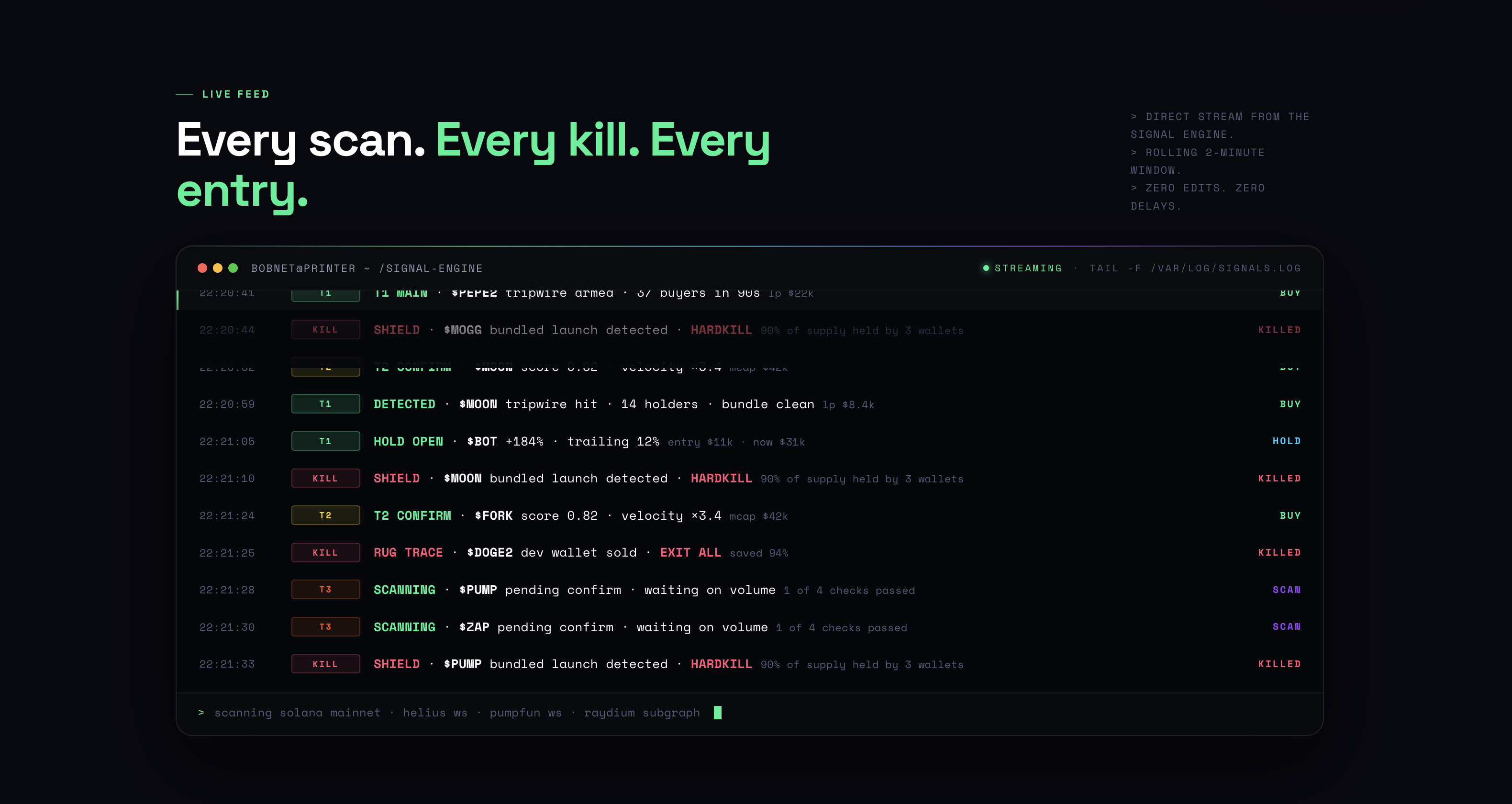
Anatomy of a signal card
Every call is delivered as a card — in the Chrome extension panel first, and in the Discord channel a few seconds behind it. The card carries everything needed to size the trade and act on it: direction, level, the read behind it, the sizing factor, the safety verdict, the market regime at that second, and the entry market cap. See a live one, and what every part of it means →
Levels & conviction
The classification system reads each token in real time and assigns it a K conviction factor (which drives position sizing) and one of four levels. Higher level = stricter filtering = higher conviction and bigger size.
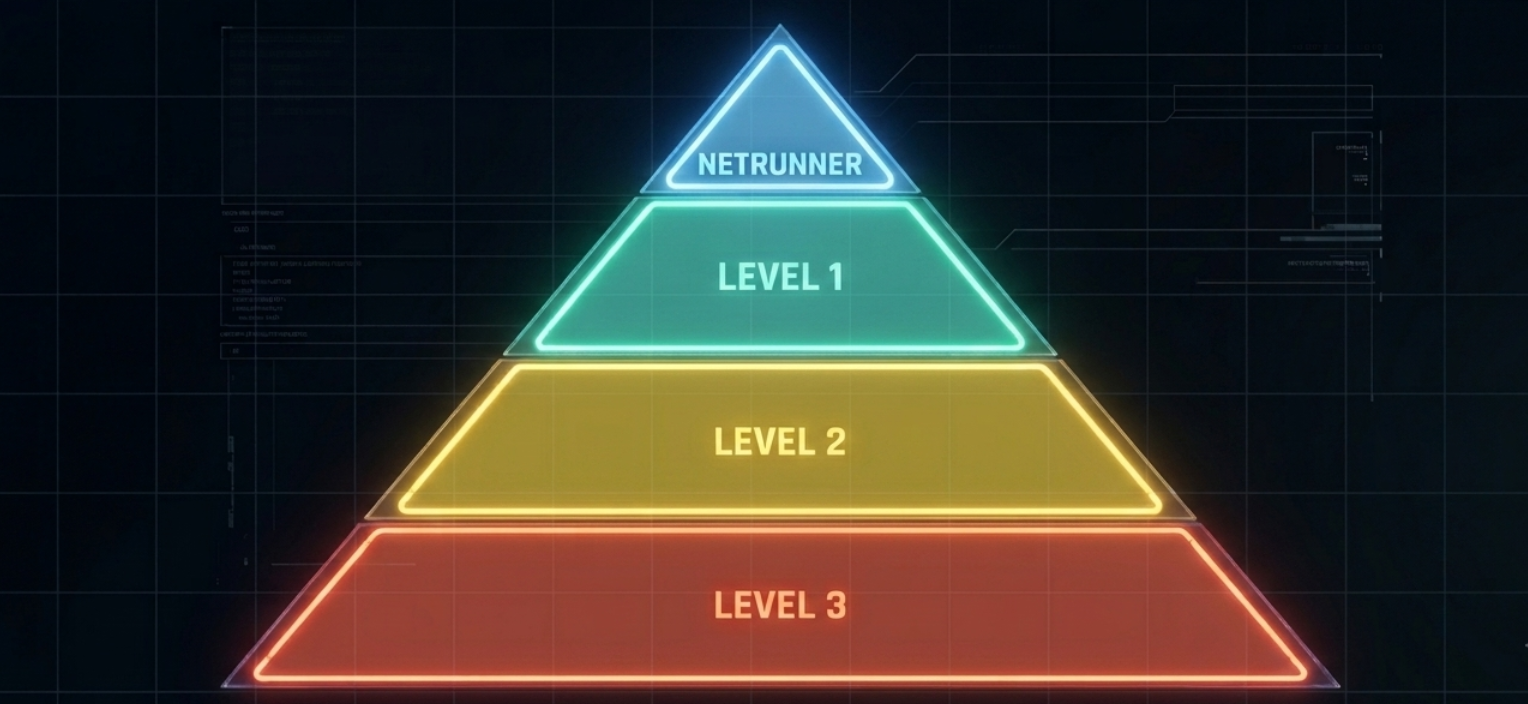
Higher tier → stricter filtering → higher conviction & bigger size
| Level | What it means | Sizing |
|---|---|---|
| 💎 Netrunner | Highest conviction — the cleanest, strongest setups (what the ICM Fund trades) | Biggest size |
| 🟢 Level 1 | Early runners — high-quality organic opportunities | Full size |
| 🟡 Level 2 | Core confirmation — solid, faster alerts | Medium size |
| 🟠 Level 3 | Widest net — most signals, minimal filtering | Small size |
The K factor travels with every signal, so the recommended size is baked into the call — and it moves with the record: a read that decays gets sized down without anyone rewriting a rule.
How the levels actually work
- Many reads, one ladder. Signals come from a family of independent reads, each looking at the tape its own way. Every read's live results are tracked separately, token by token — none of them borrows another's record.
- Ranked by live win rate. Reads are placed into levels by their actual measured performance, and re-ranked as data accumulates. A level is a performance band, not a fixed rulebook — when a read proves itself, it moves up; when it decays, it moves down or gets retired.
- Netrunner is earned, not assigned. Only the reads holding the highest live win rates sit in 💎 Netrunner. It isn't a label we hand out — it's the top of the measured table, and that's why it carries the biggest size.
- K is calibrated on real outcomes. For the setups the ICM Fund trades, K is calibrated on realized PnL — what the engine actually captured selling — not on peak potential. Manual-only setups carry a K based on entry-to-peak.
- Sentiment scales the risk. The market regime (risk-on vs risk-off — see Sentiment) adjusts K down when conditions sour, so the same signal gets smaller size into a bad tape.
All of it is auditable: open the dashboard, filter any level, and every signal behind its win rate is right there — entry, peak, profit.
Position Sizing (Kelly)
How much to bet — solved, not vibed
Picking winners is only half the job. Bet too big and one bad streak erases a good system; bet too small and the edge never compounds. The Printer sizes every entry with the same math professional bettors and quant desks use — the Kelly criterion, worked out at Bell Labs in 1956 — fed by the system's own live track record.
The two numbers behind every setup
For each setup, the engine keeps measuring its realized results — actual entries and exits under the real sell engine, net of fees, not "it touched 10× at some point":
- W — win rate. The share of trades that closed green.
- RR — payoff ratio. The average winner divided by the average loser.
Neither number means anything alone: a modest win rate with big winners can out-earn a high win rate with small ones — and vice versa. Only the pair decides.
Breakeven comes first
Given a payoff ratio, the win rate needed just to break even is WRbe = 1 / (1 + RR):
| Payoff ratio (RR) | Breakeven win rate | Read |
|---|---|---|
| 1.0 — winners equal losers | 50% | Coin-flip payoff needs better-than-coin-flip hit rate |
| 1.5 | 40% | Bigger winners buy tolerance for misses |
| 2.0 | 33.3% | Can be wrong twice per hit and survive |
| 3.0 | 25% | One hit pays for three misses |
A setup earns size only when its measured win rate clears its own breakeven — the gap between the two is the edge.
The Kelly criterion
k* = W − (1 − W) / RR
k* is the fraction of bankroll that maximizes compound growth — the mathematically optimal bet size for a repeated edge. It punishes greed in both directions: betting more than k* lowers long-run growth and raises the risk of ruin even when the edge is real, and a negative result means k* = 0: the correct size is no trade. The system would rather skip than bleed.
Two worked examples, in the shape the engine actually measures:
A setup that earns size
W 61% · RR 1.53 → breakeven 39.6%, cleared by +21.4 points → k* = 0.61 − 0.39 / 1.53 = 0.353. A real edge that deserves real size.
A setup that does not
W 37% · RR 1.41 → breakeven 41.5% — the win rate sits below it → k* = 0. Kelly's answer isn't a smaller bet. It's no bet.
Half-Kelly — the house standard
W and RR are estimates from finite samples in a market whose regime drifts. Run full Kelly on an overestimated edge and you're over-betting — the one mistake Kelly punishes hardest. So The Printer sizes at half-Kelly: the first example above caps at 0.353 / 2 ≈ 0.177. The classic trade-off: roughly 75% of the theoretical growth for half the variance — insurance against being wrong about your own edge.
From k* to the K on your signal card
- Base K per setup — a half-Kelly-capped fraction calibrated on that setup's realized outcomes, re-checked against its live level.
- × market multiplier — the live sentiment regime scales K down into a bad tape, so the same signal gets a smaller bet when conditions sour.
- × manipulation checks — evidence of bundled or farmed activity trims K further; the worst concentration patterns block the entry outright.
The product is the K line printed on every signal card — base × mkt — so the recommended fraction of bankroll ships inside the call itself.
Next: rolling calibration
Base K values come from point-in-time calibrations today. The engine already re-backtests every setup's realized W and RR daily; the roadmap is sizing that re-derives k* from a rolling 30-day window — shrunk toward zero on small samples, floored at zero, capped at half-Kelly — so position size follows the regime automatically instead of waiting for a recalibration.
Signal types
Every signal falls into one of two modes — the dashboard splits all of its stats the same way:
New Launches
Entered <48h of age — early-stage winners caught right as they launch, standard WR targets.
Long Runners
Entered >48h of age — established momentum that's still running, WR target adjusted by market cap.
Printing Room
The live signal screener — every level, one filterable feed. Filter by level, by lifetime (new vs long-running) and by market cap, then quick-buy straight off the feed with a preset SOL size. The trading floor: watch the tape and act in one tap. Each chain has its own Printing Room — Solana and Robinhood Chain run side by side.
Terminal coming soon
An innovative trading interface that replaces manual chart analysis — the command deck for reading the tape and acting on it without leaving the dashboard.
API Mode coming soon
API Mode sells Bobnet AI Ultra's live trading decisions directly, pay-per-signal — no subscription, no account, and we never touch your funds.
Non-custodial by construction
- No account, no login. There's nothing to sign up for and nothing tying a payment back to an identity.
- Your keys never leave your machine. The agent you run locally stores a path to your own wallet keypair — never the key itself, never sent anywhere.
- We don't hold your funds. Every trade is signed by your own key, on your own machine. Nothing here can move money without that signature.
How payment works — x402
Each signal (a ▲ buy or ▼ sell decision) is paid for individually over x402, an open protocol that turns the HTTP "402 Payment Required" status into a real payment: your agent requests the latest decision, pays a small amount of USDC on Solana for that one signal, and receives it. Checking whether anything new has fired is always free — you only pay when there's an actual decision to act on.
Price scales with conviction: it's a percentage of the K sizing factor already on every signal card, so a high-K call costs more than a low-K one — same logic that already drives position size everywhere else in the system.
What "installing" actually does
There's no dashboard login for this — you run a small agent on your own computer. Installing it walks you through a short, one-time setup: point it at your wallet keypair, set a daily spending cap, and decide whether it just hands you signals or also executes them for you (see below). That's the whole thing — after that it runs on its own.
Optional: automatic execution
By default the agent only fetches and pays for signals — you decide what to do with them. Turning on execution lets it act for you with your own key: entries sized to the signal's K, exits managed by a trailing-stop strategy (arms after a set gain, trails from the peak, hard-stops on a set loss). Still your key, still your machine, still nothing custodial — this is opt-in convenience on top of the signal feed, not a separate product.
ICM Fund (Vault) live wallet soon
The ICM Fund — formerly AFK Mode — is the engine trading its own signals end-to-end, with the Vault as its execution wallet. Turn it on and the system enters, holds and sells by the rules — you wake up to the result instead of babysitting charts.
How it trades
- Entries — only confirmed signals at the conviction levels cleared for autotrading, taken at the moment they fire. A level that has not earned its size is not traded at all.
- Sizing — each entry is sized by its K factor, so conviction drives exposure automatically.
- Exits — a profit ladder takes partial profits into strength, a trailing stop rides whatever's left, and a hard stop protects the downside. No emotion, no hesitation.
Results — live simulation
The engine trades its own signals on cached 1-minute price data (kline-verified), sized half-Kelly per setup and compounded chronologically from a 10◎ bank. This is a dated snapshot of the run you can regenerate any time from the ICM Fund tab — every figure below is realized, not "it touched 10× at some point".
| Level | n | WR | Med | Avg | 2× | 5× | ROI | PnL◎ |
|---|---|---|---|---|---|---|---|---|
| 💎 Netrunner | 48 | 44% | −13% | +34% | 9 | 3 | +11% | +19◎ |
| 🟢 Level 1 | 81 | 72% | +21% | +22% | 3 | 0 | +21% | +73◎ |
| 🟡 Level 2 | 147 | 70% | +19% | +9% | 0 | 0 | +11% | +68◎ |
| Σ All levels | 276 | 66% | +18% | +17% | 12 | 3 | +14% | +160◎ |
- Netrunner is high-variance: median −13% but average +34% — most trades are small losses, a few big runners carry it (9 hit 2×, 3 hit 5×).
- Levels 1–2 are the steady base: ~70% win rate, tight positive median, most of the SOL PnL.
- ROI is per-SOL-deployed; bankroll return is far higher because wins are recompounded.
Today the ICM Fund tab shows this simulated run — bank, open positions, recent exits and the equity curve. The live execution wallet is next; when it connects, the same tab switches to the real thing. You always keep custody of your own wallet and keys — The Printer never asks for your seed phrase.
Coming soon
Interactive AI Agent
The agent takes the controls — run the whole dashboard, and the Sniper, with nothing but prompts. This milestone completes the beta MVP, and access closes behind it.
Agentic Trading
x402 private trading and the integrated Sniper & Wallet — buy a signal the moment it fires, with MEV protection, one tap from the signal card.
New chains
Robinhood Chain is already live for members — its own radar, its own screener, its own long-runner board and its own caller ranking, all running on their own pipeline. BNB Chain is next, with more behind it. See Chains.
Meta-Brain
Narratives move memecoins. Meta-Brain tracks the live metas — the themes traders are piling into — ranks them, and shows the leaders and the fresh tokens lining up behind each one. It's how you see which story is running before you pick a token inside it.
Sentiment
The market backdrop you're trading into — split into three questions, each answered by its own live read:
① Macro
"How's the sea today?"
The big-picture read — bullish, neutral or risk-off — from BTC/SOL trend and systemic liquidity, refreshed daily. It sizes the whole day's risk on a Danger → Caution → Normal → Warm scale.
② Momentum
"What's minting right now?"
A live read on how many clean runners the chain is producing this hour, and how much of that is pump-and-dump froth versus the real thing — the selectivity of the moment.
③ Trading, live
"Is anything killing me right now?"
Real-time BTC/SOL price action plus a kill-switch check — the fastest-moving layer, catching a sudden risk-off move mid-session before it hits your bag.
When conditions sour, the system tightens up automatically — this is the same regime that scales K down in Levels & conviction. The tab also carries a live recap of what's moving on X (Twitter) alongside the three reads.
AI Agents
Meet Bobnet AI — the one AI Agent live today. It lives on the dashboard and inside the Chrome extension, wired into the same data the engine trades on: ask it and it pulls the on-chain picture for you, or let it read a single signal and tell you what it sees.
Default behavior
- Talks trading, on your data. Ask it about signals, win rates, runners, metas or sentiment — it answers from the live system, not from canned text.
- Sees what you see. It reads the live dashboard state while you chat, so "what am I looking at?" gets a real answer.
- Works with real tools. For deeper questions it queries the system's own data layers — and shows what it's doing while it digs.
- Reads one signal at a time. From the extension, a tap on any signal card runs an AI read on the token behind it — what it is, what the chain is doing, where the risk sits.
- Speaks your language. Ask in English, Spanish, Chinese, whatever — it locks onto the language you use.
- Guards the alpha. It explains the system without leaking the recipe — the edge stays behind the wall.
Chatting runs on agent credits, bundled with every membership — see Get access.
T-Bob & Asira — the faces on X
The system's two characters live on X for now — fronting the brand while Bobnet AI runs the desk.
The operator character — talks metas, signals and deployer culture on X.

The analyst character — narrates sentiment and market stories on X.
Roadmap
The plan is deliberately adaptive — ship, learn, iterate.
Phase 1 — The Printer ICM & AI Agents launch
Ship the core product: the signal engine, the Total Control Dashboard, and the first AI agents.
Phase 2 — 2026 expansion
Mainstream the AI and expand the automation. Shipped so far: the Terminal, API Mode, the Chrome extension — now the flagship surface — Robinhood Chain live on its own pipeline, and signal delivery moved to Discord. Next up: the ICM Fund live wallet, agentic trading (x402 + Sniper & Wallet), BNB Chain and more, and the interactive AI Agent that runs the dashboard and the Sniper on prompts.
Phase 3 — the doors close
The interactive agent completes the beta MVP. When it ships, access closes — the member cap locks and new seats stop being sold.
Team
A core team of development, trading and marketing specialists, plus early supporters. Explicitly built as a long-term product — not a pump & dump project.
FAQ
Is this financial advice?
No. The Printer provides data and educational information only. Every trade is your own decision — see Risk & legal.
What is the ICM Fund?
The automated mode (formerly AFK Mode) where the engine trades its own signals end-to-end — entries, K-based sizing, ladder exits. Its simulated track record runs live in the dashboard's ICM Fund tab; the live execution wallet is the next step. See ICM Fund.
Which chains are supported?
Two chains run live today. Solana is fully open to the public. Robinhood Chain is live for members on its own pipeline — its own token universe, its own candle feed, its own runners board with per-row verification, and a live caller ranking — at /hood (members). BNB Chain and more follow. See Chains.
How fast are the signals?
Real-time. A signal reaches the Chrome extension in about a second, and Discord a few seconds later — median 17s, 8 in 10 under 30s, and in the Chrome extension side panel in under a second — pushed over a live connection, not polled. If the safety check clears after the message is already out, the message itself is edited so you see it. The public dashboard runs on a short delay from the live engine.
Where do the signals arrive?
Two places, both live: the private Discord and the Chrome extension side panel. Telegram is the front door and the announcement channel — it is not where signals are delivered. See Chrome Extension.
What is Runshot?
A studio inside the Chrome extension: it turns a signal into a ready-to-post promo video — the alert as it arrived, its level, and the chart replayed from the call onward.
Do you hold my funds?
Never. The ICM Fund trades from your own wallet — you keep custody and keys at all times. We will never ask for your seed phrase.
What do I need to get in?
Grab a membership — start at the Telegram front door, or go straight to Get access. Membership opens the private Discord, where the signals land, plus the dashboard and the Chrome extension.
Will access stay open?
Not forever. The beta MVP is open and capped today; when the interactive AI Agent ships, access closes to new members. If you want in, this is the window.
Can I lose money?
Yes — memecoins are extremely high-risk and you can lose everything you put in. Only trade with money you can afford to lose completely.
Risk & legal
Trading crypto is risky. The Printer provides data and educational information only — not financial advice. Memecoins — on Solana, Robinhood Chain, BNB or any other chain — are extremely high-risk and you can lose all of your funds. Past performance never guarantees future results. You bear full responsibility for any decisions or losses.
See the full Terms of Service, Privacy Policy and Disclaimer.
See you in the trenches.
Hasta la vista, baby!


 Binance